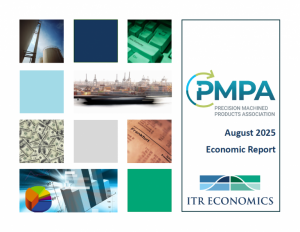
The August 2025 ITR Economics report has been released. The ITR Economics quarterly forecast report gives us insight into eight industries that are the primary drivers of our shops’ success. The ability to consistently look into the future with actionable data gives us a competitive edge.  The reason that PMPA members closely follow the ITR Quarterly forecast report is that the ITR process of analysis clarifies and makes patterns clear that the news cycle seems to miss.  The August report still shows moderate growth for this year and industrial production. “Rising input costs, cautious end-market demand, and muted volume gains all underscore the importance of cost discipline, pricing strategy, and capital efficiency.”   Check out in this month’s PMPA May 2025 Economic Report from ITR Economics.

View/Download


The Institute for Trend Research (ITR) quarterly reports focus on major areas of economic growth and decline in key market segments for the Precision Machined Products Industry. They are provided to PMPA members as part of the association’s overall business intelligence program and are used as a management tool to help PMPA members plan for what lies ahead and which markets they should focus on in a complex manufacturing environment. 

PMPA Craftsman Cribsheet #142: Techniques to Help Beat the Heat

Published August 1, 2025

By David Wynn, Director of Technical Services & Industry Affairs

Download/View Cribsheet

Now that we have hit the dog days of summer, we are all looking for ways to beat the heat. Whether a person is on the shop floor or at home mowing the lawn, these techniques can help them stay cool. 

Use Cooling Towels
Wrap cooling towels around the neck or wrists near major arteries. This will help cool the whole body. The process of the water evaporating takes energy, and that energy is removed from the towel in the form of heat, which cools the skin. The blood circulating around the towel cools as it passes by, which assists to cool the whole body. 

Wear Moisture-Wicking Fabrics
Moisture-wicking performance shirts help pull the moisture from the body and allow the moisture to quickly evaporate. Faster evaporation quickly cools the body. This effect is enhanced by moving air from fans or a breeze. These fabrics feel cool to the touch. 

Use Cooling Headbands
Cooling headbands come in many varieties. Modern, super-absorbent materials can hold substantial amounts of water, providing longer-lasting cooling power. The materials can absorb 500-800% of their weight in water. The water slowly evaporates, providing a cooling effect on the head, where 15-20% of the body’s blood flows every minute. 

Wear a Cooling Vest
If the level of heat is extreme, a cooling vest can provide some relief. Vests are typically filled with ice water to help shield the body from heat and assist cooling in extreme conditions. Depending on the environment, these can last from a few minutes to several hours. 

Use Neck Fans 
Notice a theme of cooling areas where substantial portions of blood flow? Neck fans create airflow around the carotid arteries, helping to cool the body through evaporation of sweat. 

Stay Hydrated
Having a cup of ice or ice water to melt in your mouth works because a large amount of blood flows through the head. Cooling the blood vessels around the mouth will help cool the rest the body. 

I know what you are thinking, fluids are not a technique. But I include it because our most important technique to beat the heat is our own bodies’ cooling mechanism: sweat. In order to sweat, the body needs plenty of fluids. Without fluids the body will quickly overheat and become dehydrated. Staying hydrated will allow your body to readily maintain a steady temperature. 

It is hot outside, but that does not mean you have to be hot. Stay cool and comfortable during the dog days of summer. Be safe, stay hydrated and stay cool.


Author

David Wynn

David Wynn, MBA, is the PMPA Director of Technical Services & Industry Affairs with over 20 years of experience in the areas of manufacturing, quality, ownership, IT and economics. Email: dwynn@pmpa.org — Website: pmpa.org.

STATE OF MANUFACTURING – Rhode Island Manufacturing

by Joe Jackson

Director of Communications & Events, PMPA

Published August 01, 2025

Download Magazine Article

Fabricated Metal Products Manufacturing is a subsector of manufacturing that makes critical goods from metal components.

Precision Turned Products Manufacturing is a subsector of fabricated metal product manufacturing that makes the components that MAKE IT WORK!


RHODE ISLAND ECONOMIC OUTPUT

Rhode Island Manufacturing
NAICS 31-33
$5,280,000,000

Fabricated Metal Product Manufacturing
NAICS 332
$674,912,000

Precision Turned Product Manufacturing
NAICS 332721
$70,819,000

RHODE ISLAND MANUFACTURING ACCOUNTS FOR

Manufacturing Is Productivity –7.1% of Rhode Island’s total output. (GDP)

Manufacturing Builds Businesses –1,547 manufacturing establishments in the state of Rhode Island.

Manufacturing Creates Jobs – Jobs: 8.46% of all Rhode Island’s employees are in the manufacturing sector.
(41,000 employees)

Manufacturing produces for Rhode Island

  • Manufacturing is the fifth largest GDP Producer in Rhode Island.
  • Manufacturing employment in Rhode Island has grown 2% each year since 2019 surpassing the national average over 1.8% over that time period, with a forecasted growth of 2.4% over the next decade.

Rhode Island is a great place for a career in manufacturing

  • Manufacturing jobs pay on average 19% over the average job in Rhode Island.
  • Job sites are currently reporting over 500 available manufacturing job openings in Rhode Island.


Sources: NAM.org, US Census, statista.com, IndustrySelect.com
Data selected to show relative values. May not be directly comparable due to differences in sampling, analysis, or date obtained.


Author

Joe Jackson

Director of Communications & Events, PMPA

Email: jjackson@pmpa.org — Website: pmpa.org.

PMPA’s New Executive Director: Emily Riley, MBA

Emily Riley brings vision, energy and a deep commitment to manufacturing excellence and member service.

by Carli Kistler-Miller

Director of Programs & Marketing, PMPA

Published August 1, 2025

Download Magazine Article


I am honored to welcome Emily Riley as PMPA’s new executive director. With a career that spans education, manufacturing, innovation consulting and leadership, Emily brings a mix of experience and vision to PMPA at a time of both opportunity and growth for our organization. As stated by PMPA Board President Brian Adams, “We’re excited to welcome Emily Riley as PMPA’s executive director. Her strong leadership skills, industry insight and member-focused approach are exactly what we need to guide the association into its next chapter.”

Professional Journey
Emily began her professional journey as a high school chemistry teacher before moving into research and development and supply chain operations in the manufacturing sector. Over 15 years, she supported teams in new product development and category growth across industries including food and consumer electronics. Her experience as a consultant further broadened her impact, allowing her to help organizations develop innovation strategies and align operations with business goals. Additionally, Emily served as a program director at Rowan University, where she helped launch a sustainable food systems degree program.

Why PMPA?
Emily was attracted to PMPA because of its unique position in the manufacturing world. “PMPA is a niche within manufacturing, and it’s a powerful one,” she says. “Our members produce precision components for critical, no-fail applications. That level of excellence and commitment really resonates with me.” She can already see strong parallels between the service-oriented nature of consulting and PMPA’s mission to support member companies through resources, networking and advocacy.

At the time of this writing, Emily was just weeks into her new role and she already sees tremendous potential. “There’s a deep sense of community and passion among our members and staff,” she notes. “My vision is to increase awareness of PMPA’s value, expand our reach regionally through chapters and encourage members to both leverage and contribute to the association’s resources.”

Emily also brings a solid grounding in nonprofit management, holding a certificate from Georgetown University. PMPA offers her the chance to apply that knowledge in a hands-on way, working alongside a “small but mighty” team deeply committed to the association’s legacy of over 90 years of excellence.

As she settles in, Emily encourages members to not only take full advantage of PMPA’s offerings, but also to share their time and expertise to help strengthen the organization. “This is a community built on excellence, service and collaboration,” she says. “I’m excited to be a part of it.”


Author

Carli Kistler-Miller, MBA has over 25 years of experience with operations, event/meeting planning, marketing, writing and communications.
Email: cmiller@pmpa.org — Website: pmpa.org.

Unexpected Takeaways from the 2025
SID Congress

Seeing our industry through international eyes.

by Miles Free III

Director Emeritus, PMPA

Published August 1, 2025

Download Magazine Article


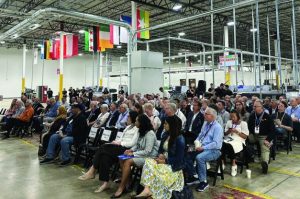
PMPA is a member of the international precision machining industry association Syndicat International du Decolletage (SID), a group of eight global associations from Europe and the U.S. Every two years, each association hosts a congress, inviting member companies to tour local manufacturing facilities and experience their culture. PMPA was proud to be the host of the 2025 SID Congress. Held June 8-12 in Chicago, the congress brought together 150 delegates and partners to visit precision machining shops, suppliers, training institutes in Chicago and Milwaukee — as well as tourist venues worthy of an international audience.

Here are my unexpected takeaways from this event:

  • The abundance of available floor space in U.S. facilities was unanimously cited as “shocking” by our visitors. Aisles in U.S. factories were said to be “many times” wider than the European practice.
  • Tariffs were neither polarizing nor the source of animosity between delegates — regardless of country. Comparison of the costs of business inputs — labor, materials and social costs — gave us all plenty of insights into the most important factors affecting our profitability. What was problematic was the difficulty of managing commercial uncertainties due to the tariff process.
  • Social costs for the workforce differed substantially by country, but their increase by all countries reporting made a compelling case for increasing investment in automation, lightly attended operations and buying higher quality materials to minimize production complexity and higher labor inputs.
  • Demand for talent and the need to grow the manufacturing workforce was universal and a major concern by every delegation regardless of country. All delegates were surprised at the claim — supported by facts — that now is actually a positive and underappreciated opportunity for our investment in automation, technology and training.
  • While many of the shops we visited had similar processes and technologies, each made a convincing case that it was their different management approach and workforce expertise that provided their advantage and success.
  • The collaboration, cooperation and sharing of the PMPA members was seen initially as “an incredible fantasy.” But by the end of our shop visits, our visitors agreed that the sharing between “competitors was unlike anything they had ever experienced and undeniable in its strength.” (This is how we explain PMPA member shops’ better-than-benchmark performance.)
  • The delegates all shared how welcomed and comfortable they felt, unlike the image of the U.S. that they get from their media. 
  • Many attendees were surprised by the apparent abundance they saw on the tours — whether the amount of dedicated greenspace on our industrial properties, the size of homes or the sheer abundance of supplies and products readily available in our shops.
  • After five days of networking, conversations, presentations and meetings to share data and best practices, many of our visitors were using the term “better together” to describe their experience at SID 2025. Whether the wide expanse of manufacturing space available, the automation and technologies they witnessed — or the delight at learning how to grill a steak “American-style” at Weber Grill or sample the tastes of Chicago. 

SID 2025 was a singular opportunity to see, feel, taste and learn just what in the world our industry is up to. Better together — sharing, networking — we couldn’t agree more. It was a pleasure to host, participate and learn. Despite the anger in the world news, we found that people with shared interests and mutual needs had plenty of good will — and sharing of our data made our mutual future success much clearer.


Author

Miles Free III is the PMPA Director Emeritus with over 50 years of experience in the areas of manufacturing, quality and steelmaking. Miles’ podcast is at pmpa.org/podcast. Email Miles


Advancing Workforce Talent: PMPA Joins Forces with Navy Talent Pipeline Program


(BRECKSVILLE, OH) – The Precision Machined Products Association (PMPA) is expanding its collaboration with the U.S. Navy’s Talent Pipeline Program (TPP) to support talent acquisition, training, and retention across the Navy’s defense industrial base (DIB).

As highlighted in recent industry reports, critical components of the U.S. manufacturing base —particularly skilled trade positions — have seen a steep decline in recent decades. The TPP is helping to reverse this trend by equipping small and medium-sized manufacturers with tools, training, and support to enhance how they recruit, develop, and retain high-performing team members essential to sustaining U.S. manufacturing.

Building on a successful collaboration in PMPA’s Eastern New England, Connecticut and Southern California Chapters, PMPA and the TPP are working together to expand the program’s reach nationwide through PMPA’s membership network. PMPA’s Chapters will play a key role in helping member companies benefit from this initiative.

“This collaboration aligns perfectly with PMPA’s mission to advance and sustain the precision machining industry,” said PMPA Executive Director Emily Riley. “By connecting our members with the Navy’s Talent Pipeline Program, we’re providing a powerful resource to help companies strengthen their workforce and support national security goals through manufacturing excellence.”

Joe Barto, program leader of the U.S. Navy Talent Pipeline Program, welcomed PMPA’s involvement, stating: “Partnerships with national facilitators like PMPA are vital to the Talent Pipeline Program’s national rollout. Their support validates the Navy’s investment in small and medium-sized manufacturers—the backbone of American industry and the majority of PMPA’s membership. By joining the movement alongside more than 450 employers, PMPA is helping ensure companies have the talent they need to build high-performing teams.”

The Talent Pipeline Program directly addresses the U.S. Navy’s growing manufacturing production requirements by ensuring a steady pipeline of skilled talent to deliver and sustain Columbia and Virginia-class submarines, aircraft carriers, surface combatants, and vessels currently in service. This expanded initiative will reinforce U.S. naval capabilities and fortify national security in an increasingly complex global environment.


Learn More


TPP Realistic Program Preview


PMPA Craftsman Cribsheet #141: 10 Things We Learned at Horn Technology Days 2025

Published July 1, 2025

By David Wynn, Director of Technical Services & Industry Affairs | Miles Free, Director Emeritus, PMPA

Download/View Cribsheet

Horn Technology Days 2025 is an exposition that both teaches and demonstrates technology so you can experience the entire process. It is far more than an open house. The best way to describe it is a partnership between Horn and partners to share best practices using the latest technology. 

Here are 10 things we learned at the 2025 Horn Technology Days:

  1. Climb milling is the preferred process, not conventional milling. Conventional milling was traditionally utilized because of backlash. Modern equipment compensates for backlash allowing climb milling, which reduces heat and horsepower needed and improves tool life. 
  2. Y-axis cutoff reduces chatter and allows cutting forces to more efficiently be pushed into the toolholder, allowing for faster feeds and increased tool life. 
  3. Utilize turn milling on thin wall parts and long stick outs.  Lower clamp pressure is required because spindle is rotating slowly while the tool provides the speed for cutting.  
  4. Even though they were machining tool steels, the chips that we checked in the chip buckets were in control, showed signs of heat and seemed to be just as well managed as the final parts produced. 
  5. Turn-milling breaks chips more effectively in long-chipping, difficult-to-machine alloys. With 3D-machining techniques and multiflued tools, chips are easily managed in super alloys. 
  6. Tool geometry is the key to running automated production. One key factor in running unattended production is chip control. Having the correct tool geometry is the first step in controlling chips. 
  7. A single-flute mill with appropriate coating and geometry can achieve ground-like finishes. We saw milled parts that we could not distinguish with our eyes that they were not ground. 
  8. Incremental improvement in our shops and processes is necessary, but insufficient for achieving major innovation. Continuous improvement is more of a “healing system” for sustaining existing processes. Major innovation is how we grow our capabilities to meet ever-changing market demands. “Hunker down” is not a business strategy; it is capitulation.
  9. The move to unleaded steel and brass materials in our shops has finally arrived in full force. Tools are available with geometries to help meet the production levels that have been met using leaded materials. The biggest potential problem to solve is no longer lower productivity due to the absence of lead; it is the potential loss of recovered value from scrap if the various varieties of unleaded brass are mixed or intermingled. Maintaining separation of scrap streams is critical. Mixing different grades will prevent recovery of expected scrap value. Segregate chips, bar ends and actively manage a process for maintaining material identity throughout your process.
  10. Immaculate housekeeping is not only possible but is a critical factor in making the process visible, eliminating wasted time, motion and materials and ensuring equipment maintenance is on track. 

How much money and time could your shop save if you implemented these lessons? Where can you and your team go to learn the latest to sustain your competitiveness?


Author

David Wynn

David Wynn, MBA, is the PMPA Director of Technical Services& Industry Affairs with over 20 years of experience in the areas of manufacturing, quality, ownership, IT and economics. Email: dwynn@pmpa.org — Website: pmpa.org.

Change Leadership vs. Change Management: Why You Need Both

Change is necessary for continuous improvement. Knowing the distinction between change leadership and management can be the difference between success or failure.

by Carli Kistler-Miller

Director of Programs & Marketing, PMPA

Published July 1, 2025

Download Magazine Article


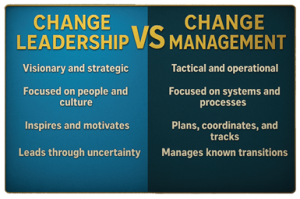
Change. It’s inevitable and necessary for a business to grow or adapt. Some people accept change and others resist. When looking to guide employees through change, it’s important to understand the difference between change leadership and change management. 

Change Leadership
Change leadership is the practice of guiding and influencing people through organizational change. It focuses not just on managing the logistics of change but also inspiring, aligning and equipping people to embrace and drive change forward.

Some of the key aspects of change leadership are:

  • Being vision-oriented. Define a compelling future and communicate why the change is necessary.
  • Being people-focused. Recognize that change can be emotionally and professionally challenging. Focus on empathy, communication and support.
  • Being proactive and adaptive. Anticipate resistance and obstacles. Stay flexible and responsive to employee feedback.
  • Influencing. Influence isn’t authority. Influence uses trust, credibility and engagement to motivate others, rather than relying on positional power alone.
  • Driving culture. Encourage new ways of thinking and behaving, not just new processes or structures.

Change Management
Change management is the systematic approach to dealing with the transition of an organization’s goals, processes, technologies or people. It involves strategies and tools to help individuals and teams move from a current state to a desired future state effectively.

Some of the key aspects of change management are:

  • Planning. Define the change, set objectives and identify key stakeholders.
  • Communication. Inform and educate those affected by the change. 
  • Training and support. Provide the resources and knowledge people need to succeed in the new environment.
  • Monitoring and feedback. Measure progress, gather input and make adjustments. 

Why the Distinction Matters
Understanding the distinction helps leaders address both the technical and the human sides of change. Change management ensures the logistics are in place (plans, training, timelines). But without change leadership, people may resist, disengage or revert to old habits. Leadership drives the “why” — the emotional and cultural commitment needed for lasting change. Different skill sets are required, so the owner may provide change leadership and the plant manager may provide change management. 

Change is both rational and emotional. One without the other can lead to failure. Strong management without leadership equals technically sound plans, but poor adoption. Strong leadership without management equals energized people, but chaos or confusion. 


Author

Carli Kistler-Miller, MBA has over 25 years of experience with operations, event/meeting planning, marketing, writing and communications.
Email: cmiller@pmpa.org — Website: pmpa.org.